
Reviewed · WALKING TOURS
Ancient Trees of Vancouver Walking Tour
Some of Stanley Park’s greatest sights are not the seawall or the skyline. They are the ancient western red cedars and Douglas firs hidden along the park’s forest trails. Some trees are hundreds of years old, and a few are estimated at close to a millennium.
I like the small group size, capped at 10 people, and the way guide Colin Spratt combines tree science with Vancouver history, Coast Salish culture, old photos, and local stories. The main drawback is practical: you must get yourself to Ferguson Point, and three hours on foot may feel long if trees are not your main interest.
In This Review
- Key points to know before you book
- Why Stanley Park’s old trees are the real attraction
- Meeting Colin Spratt at Ferguson Point
- Following the forest trails for three hours
- Meeting a 1,000-year-old western red cedar
- Looking up at the Douglas firs and maples
- Seeing Stanley Park through maps, postcards, and photographs
- The conservation message behind the beauty
- How the tour compares with other Stanley Park activities
- Is $56.33 a fair price for three hours?
- Who should book this walk?
- Should you book the Ancient Trees of Vancouver tour?
- FAQ
- Where does the Ancient Trees of Vancouver tour start?
- Where does the tour finish?
- How long is the walking tour?
- How many people can join the tour?
- Is the tour offered in the morning and afternoon?
- What is included in the experience?
- Is transportation included?
Key points to know before you book
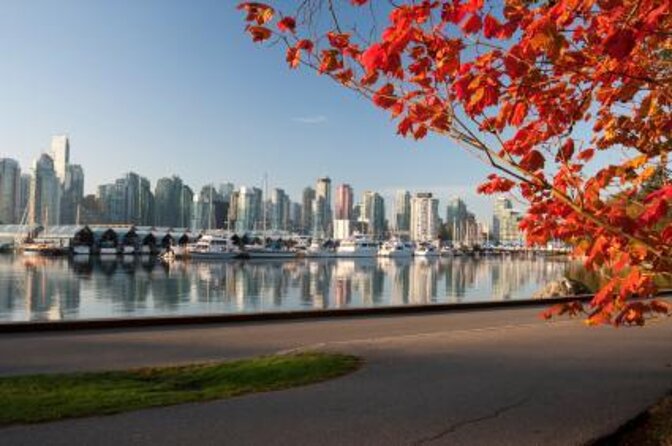
- Ancient trees inside the city: Stanley Park protects some of Vancouver’s last old-growth forest, including huge cedars and Douglas firs.
- Colin Spratt leads the walk: He is a big-tree seeker and member of the BC Big Tree Committee, with a clear passion for forest conservation.
- Historic visual aids: Old maps, photographs, and postcards from about 120 years ago help connect the trees to Vancouver’s past.
- Small groups matter: With no more than 10 participants, you can hear the guide and ask questions without a crowded park walk.
- Three hours, morning or afternoon: The schedule gives you room to fit the tour around other Vancouver plans.
- Easy forest trails, but no shuttle: The walk begins and ends at Ferguson Point, and pickup is not provided.
Why Stanley Park’s old trees are the real attraction
Stanley Park is often treated as a quick stop between downtown Vancouver and the seawall. That misses much of the point. The park’s old-growth forest gives you a chance to see trees that began growing long before Vancouver became a modern city.
The most impressive sights are the giant western red cedars and Douglas firs. The cedars can be broad, hollow, and oddly shaped, with upper branches that form intricate candelabra-like crowns. The Douglas firs rise high above the trail, giving the forest its cathedral feel without any built structure.
The age claims vary by tree. You can expect to hear about specimens estimated at 500, 600, 800, 1,000, and even around 1,300 years old, depending on how the tree or its remains are assessed. That uncertainty is part of the lesson. Age is not always easy to measure in a living tree, especially when the trunk is hollow or when several generations grow from the same fallen log.
You will also look for the largest known maple tree in Canada, along with massive stumps and trees that show how an old forest keeps renewing itself. This is not a parade of famous viewpoints. The appeal comes from learning how to read the forest.
More walking tours around Vancouver:
- Gastown Historic Walking Food Tour
★ 5.0 · 1,863 reviews - Vancouver Lost Souls of Gastown Walking Tour
★ 5.0 · 1,273 reviews - A Wok Around Chinatown: Culinary and Cultural Walking Tour Led by a Chef
★ 5.0 · 610 reviews
Meeting Colin Spratt at Ferguson Point
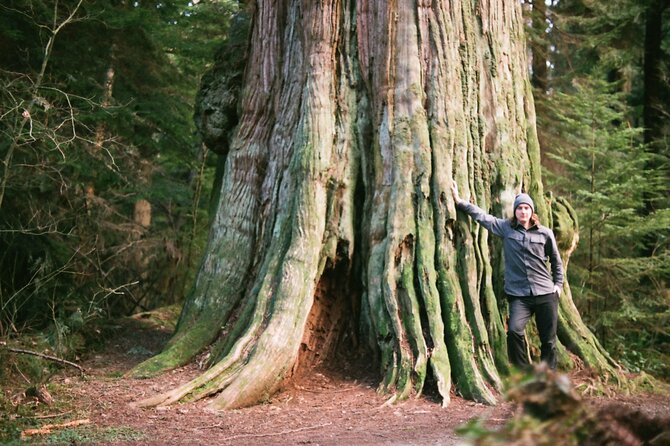
The walk starts at Ferguson Point, at 7501 Stanley Park Drive. You arrange your own transport to the meeting point, and the experience finishes there after roughly three hours.
That location makes sense for a forest tour, but it is worth planning carefully. This is not a downtown walking tour with hotel pickup. If you are fitting it into a busy day, allow time to reach Stanley Park and find Ferguson Point without rushing.
Colin Spratt is the central reason this walk feels different from a standard park stroll. His work as a big-tree seeker and his connection with the BC Big Tree Committee give him a specialist’s eye, but his approach is not limited to measurements and species names.
He connects trees to the growth of Vancouver, the making of Stanley Park, logging, conservation, and the original Coast Salish communities who lived here for thousands of years. His storytelling also includes local legends, personal observations, and historical images.
The small group limit helps. Ten people is still enough for conversation, but not so many that you are standing at the back of a crowd. If you like asking questions, this format gives you a better chance to do so.
Following the forest trails for three hours
The itinerary is listed as one extended Stanley Park walk rather than a series of separate stops. That is a strength. You are not repeatedly getting on and off transport or moving between unrelated attractions.
Instead, Colin leads you along park trails toward the most notable old trees. The walking is described as easy, though it remains a three-hour outdoor activity. Wear shoes suitable for park paths and dress for Vancouver’s changeable weather.
The pace is built around stopping, looking, and listening. You may examine the base of a cedar, consider the shape of its crown, or see how a fallen trunk supports new growth. The tour is not about covering a large distance quickly.
That makes the walk suitable for families and for people who prefer a thoughtful nature outing to a high-speed sightseeing schedule. Children can take part as well. Colin has been praised for patiently answering questions from children aged 7 to 11 and keeping them involved.
Still, you should choose this carefully if you dislike guided walks or prefer to explore alone. The value comes from the explanations. Without interest in trees, ecology, or local history, three hours may feel slower than other Stanley Park activities.
Meeting a 1,000-year-old western red cedar
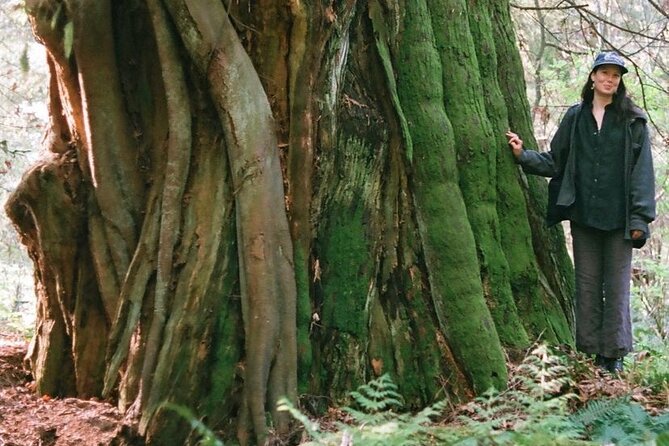
The giant western red cedars are the emotional center of the walk. One ancient cedar is described as a grandfather tree, a fitting name for a living organism that has witnessed centuries of change.
You will learn why cedar has been so important to Coast Salish communities. The wood was used for longhouses and canoes, while bark fibers supplied material for clothing, rope, and other everyday needs. Calling cedar a tree of life is not a poetic label added for tourists. It reflects how many parts of the tree supported community life.
The forest also shows that age does not always equal perfect health. Some old cedars are hollow, yet remain alive and useful. A hollow trunk can provide shelter for wildlife, including bears in the broader forest examples discussed on the walk.
You may also see a hollow cedar stump around 700 years old. That kind of sight helps you understand that the forest is not only made of upright trees. Fallen trunks, decaying wood, roots, moss, and seedlings all belong to the same system.
One of the most memorable ideas from the walk is that much of a tree’s structure is dead material. That wood still protects the living parts and feeds the next generation. A dead log can act as a nurse log, supporting new trees and other growth as it breaks down.
A different kind of day, same city:
- Vancouver Half-Day Whale Watching Adventure with Free Photos
★ 5.0 · 5,000 reviews - Big Bus Vancouver Hop-On Hop-Off Sightseeing Tour
★ 3.5 · 3,028 reviews - Victoria & Butchart Gardens Tour with Ferry from Vancouver
★ 4.5 · 2,703 reviews - Vancouver: Covered Whale Watching Adventure with Free Photos
★ 4.8 · 2,260 reviews
Looking up at the Douglas firs and maples
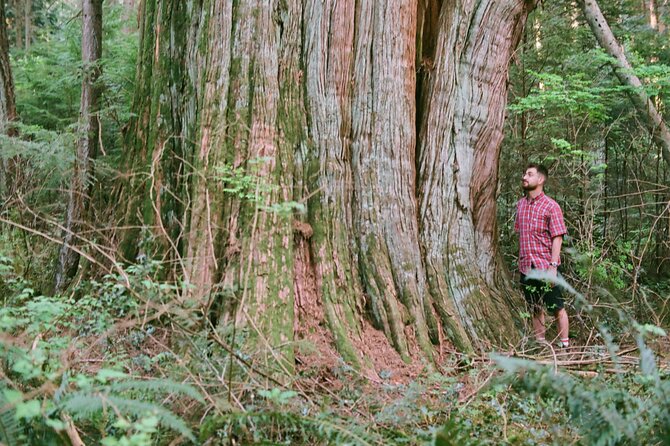
The Douglas firs give the forest a different character from the cedars. They are tall, straight, and built for height, with trunks that make you look up rather than across.
The tour includes Douglas firs estimated at roughly 600 to 800 years old. Their size is impressive, but Colin also explains the ecological role of old-growth trees and why these forests are difficult to replace. A young tree may grow quickly by forest standards, but it cannot reproduce the structure of an ancient forest in a few decades.
The maple sighting adds variety. The tour includes what is described as the largest known maple tree in Canada. The point is not only to photograph an enormous specimen. You will also gain a better sense of how species share the forest and how individual trees become landmarks within it.
Look closely at the oldest cedars’ upper branches. Their candelabra shapes are one sign of great age. The forest rewards attention, and Colin’s explanations give you reasons to notice details you might otherwise walk past.
Seeing Stanley Park through maps, postcards, and photographs
The old trees are not isolated from human history. They survived as the city expanded around them, and the tour uses old maps, photographs, and postcards to show how Stanley Park changed over time.
The visual material includes postcards about 120 years old. This is especially useful because it lets you compare the park’s earlier appearance with what you see today. A large tree becomes more meaningful when you understand its place in the story of the city.
The walk also addresses the park’s original Coast Salish inhabitants. That context matters. Stanley Park was not an empty wilderness waiting to be discovered, and a good forest tour should make that clear.
You will hear about how Vancouver’s urban development, logging, and conservation efforts affected the area. The trees become records of those changes. Their scars, size, survival, and location can tell part of Stanley Park’s story.
This blend of natural and human history is one of the tour’s strongest features. If you already enjoy museums, historical photographs, or local storytelling, you will likely appreciate how the material is brought outdoors rather than confined to a display case.
The conservation message behind the beauty
The tour is not simply a celebration of enormous trees. It also explains the threats facing old-growth forests today.
An ancient tree can survive fire and rot in ways that surprise you, yet old-growth forest remains fragile. A tree that took centuries to reach its present size cannot be replaced by planting a sapling. The forest’s value also comes from the relationships among old trees, fallen wood, seedlings, soil, and wildlife.
Colin’s conservation work shapes the tone of the experience. He encourages you to see trees as living systems rather than scenery. That change in outlook is practical: after the walk, you may notice hollow trunks, nurse logs, root systems, and crown shapes in parks you once crossed without a second thought.
The subject can become serious, but the tour is not presented as a lecture. Humor, stories, historical details, and hands-on observations keep the walk moving. The best moments come when a fact changes the way you see something directly in front of you.
How the tour compares with other Stanley Park activities
A bicycle ride around Stanley Park is a good way to cover more ground. The seawall gives you water views, city views, and a strong sense of the park’s scale.
This walking tour does something different. It takes you away from the main urban attractions and focuses on forest details that are easy to miss from a bicycle. You will not see every part of Stanley Park, but you will understand a small part of it much better.
You can also pair the walk with other park activities if your schedule allows. A tea restaurant before or after the tour was specifically suggested as a nearby addition, though the experience itself does not include food or refreshments.
The best comparison is simple:
- Choose a bike ride for distance and broad park views.
- Choose the ancient-tree walk for close observation and interpretation.
- Choose both if you want a general introduction to Stanley Park followed by a more focused forest experience.
Is $56.33 a fair price for three hours?
At $56.33 per person, this is not the cheapest way to spend time in Stanley Park. You can walk the park’s public trails without paying an admission charge.
The price makes more sense if you value expert interpretation. Colin’s role is not just to point out a big cedar. He explains how the tree may have reached that age, what happens inside a hollow trunk, how old wood supports new life, and how the forest connects to Indigenous culture and Vancouver’s past.
The small group also improves the value. A crowded nature walk can turn into a one-way speech. With a maximum of 10 participants, the experience has room for questions and conversation.
I would see this as a specialty tour rather than a general park ticket. If you love trees, conservation, forests, photography, or local history, three hours of focused guidance is a reasonable use of your sightseeing budget. If you mainly want a scenic walk, you may prefer to explore Stanley Park on your own.
Morning and afternoon departures add useful flexibility. The tour is often booked well ahead, with an average booking lead time of 46 days, so reserve early if the timing matters to you.
Who should book this walk?
I would recommend it most strongly to:
- People fascinated by large or ancient trees
- Families with children who ask lots of questions
- Visitors who want more than standard city attractions
- Anyone interested in Coast Salish culture and Vancouver’s past
- Nature lovers who enjoy ecology and conservation
- Solo visitors who want a small, guided activity
It also suits couples looking for a quiet break from urban sightseeing. The forest provides a change of pace without requiring a trip outside Vancouver.
You should think twice if you want a fast-moving tour, a panoramic sightseeing route, or transport included. The tour begins and ends at Ferguson Point, and there is no pickup or drop-off service.
Most people can participate, and service animals are allowed. Free cancellation is available if you cancel at least 24 hours before the start time. Cancellations or changes made inside that 24-hour window are not accepted for a refund.
Should you book the Ancient Trees of Vancouver tour?
Book it if you want to understand why Stanley Park matters, not just take a picture beside it. The huge cedars and Douglas firs are the draw, but Colin Spratt’s mix of ecology, Coast Salish history, old photographs, conservation, and humor gives the walk its lasting value.
I would not book it only because you have three spare hours in Vancouver. Book it because you want a close look at old-growth forest and are willing to let the trees set the pace.
For a small group, a specialist guide, and access to some of the city’s most remarkable living landmarks, the tour offers a focused and memorable experience. It is one of the better choices in Vancouver for anyone who wants nature to be more than a backdrop.
FAQ
Where does the Ancient Trees of Vancouver tour start?
The tour starts at Ferguson Point, 7501 Stanley Park Drive, Vancouver, British Columbia V6G 3E2.
Where does the tour finish?
The activity ends back at the meeting point at Ferguson Point.
How long is the walking tour?
The tour lasts approximately three hours.
How many people can join the tour?
The tour has a maximum of 10 participants.
Is the tour offered in the morning and afternoon?
Yes. Morning and afternoon tour times are available.
What is included in the experience?
The tour includes a guided walk, ancient western red cedar trees, towering Douglas firs, Colin Spratt as the guide, and historical maps, postcards, and photographs used during the storytelling.
Is transportation included?
No. Pickup and drop-off are not included, so you must make your own way to Ferguson Point.
Just added around Vancouver
- Private Vancouver City Amazing Highlight Tour With Chinese Garden★ 5.0 · 3 reviews
- Private Chauffeured Airport to Whistler Transfer (YVR – Whistler)★ 3.5 · 3 reviews
- Stanley Park Self Guided Bike Tour★ 5.0 · 3 reviews
- Unforgettable Whistler ( Full Day Private Tour)★ 5.0 · 3 reviews
- Experience the Beauty of Vancouver’s Forests by Bike/E-Bike★ 5.0 · 3 reviews
- Private Accessible Vancouver Airport (YVR) Transfer to City of Vancouver★ 5.0 · 3 reviews
- Private Chauffeured Whistler Transfer (Vancouver to Whistler)★ 4.0 · 3 reviews
- 3 Hour Kayak in Vancouver with Coffee on the Beach★ 5.0 · 3 reviews
Walking Tours, compared.

A Wok Around Chinatown: Culinary and Cultural Walking Tour Led by a Chef
Read our review →
The Forbidden Downtown and Gastown Walking Tour
Read our review →
Gratuity-Based Vancouver City Highlights 3 Hour Walking Tour
Read our review →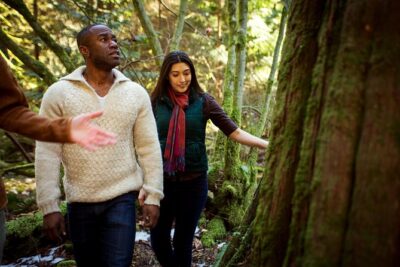
Experience Gastown Vancouver’s Elite Walking Food Tour
Read our review →
Browse the lists this tour appears in